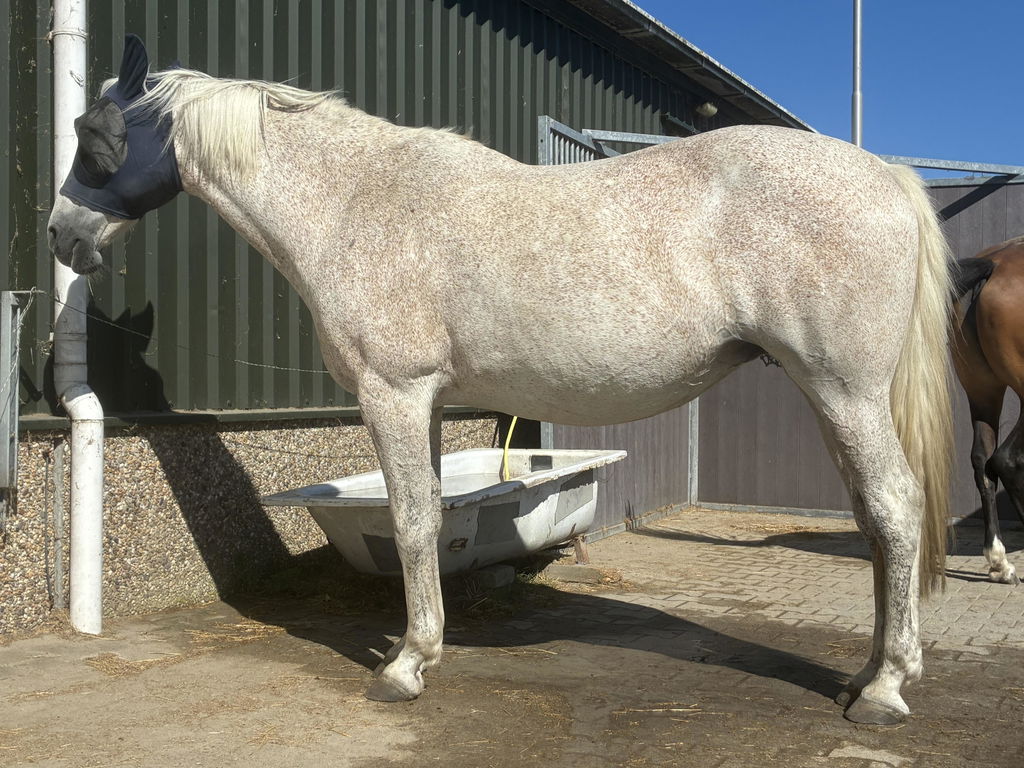

During the stabling season it happens more often than you might think: horses with gastric ulcers. It may sound like something rare, but nothing could be further from the truth. Under the name Equine Gastric Ulcer Syndrome (EGUS), gastric ulcers are remarkably common in sport horses and leisure horses alike. In sport and leisure horses the figure lies between 17 and 58%, in racehorses and endurance horses even between 50 and 93%. Foals are not safe either: around weaning, gastric ulcers are found in 82% of them.
Why horses are so sensitive
A horse's stomach was made for a different life than many of our horses lead today. In nature, horses graze small amounts all day long, and their stomach is geared to that constant supply of roughage. That is why the stomach produces acid 24/7. This acid kills pathogens and helps with digestion.
But when there is no constant flow of feed coming in, the acid just sloshes around in the stomach with nothing to do. The corrosive acid can then attack the stomach wall and cause small wounds, which eventually become ulcers. The upper part of the stomach is especially exposed when a horse has to work on an empty stomach.
If a horse also suffers from chronic stress, things go wrong twice over. Stress reduces blood flow to the entire gastrointestinal tract. As a result, nutrients are absorbed less well and the stomach wall receives less oxygen and fewer building blocks. The consequence? The protective mucus layer becomes thinner, making the stomach even more sensitive to acid.
Two types of gastric ulcers
A distinction is made between ulcers in:
- the upper, non-glandular part of the stomach. These are the most common and are strongly linked to feeding and housing.
- the lower, glandular part. These are more persistent and are often caused by stress, both physical and emotional.
Stress factors such as competition nerves, transport and box rest play a major role here, but so do a poorly fitting saddle or girth, lack of social contact, chronic abdominal pain and the like.
Recognising the subtle signs
A horse with gastric ulcers does not always show clear signs. Still, there are a number of symptoms that should make you alert:
- Reduced appetite or weight loss
- Teeth grinding, yawning more often
- Aggression when the girth is tightened
- Recurring colic, especially after concentrates
- Crib-biting after eating concentrates
- Reduced performance and slower recovery
- Changes in behaviour (nervous, aggressive)
- Chronic diarrhoea
Please note: these signs are not exclusive to gastric ulcers. They can also be caused by worm infections or a poorly fitting saddle, for example.
What can you do if you suspect gastric ulcers?
The foundation lies in management and feeding. Think of:
- Provide at least 12 to 16 hours of roughage per day, with no feeding breaks longer than 3 hours.
- Reduce stress where possible: movement, social contact with other horses and predictability are crucial.
- Feed a handful of roughage before riding to protect the stomach.
- If needed, support with supplements that protect the stomach wall. Do not tamper with the pH of the stomach; it is acidic for a reason.
Ulcers in the upper part of the stomach can often heal by themselves once management improves. In more serious cases, your vet can provide additional treatment or perform a gastroscopy to be sure.
Ulcers in the lower part of the stomach need a longer and more complex treatment. The standard medication (omeprazole) does not always work as hoped there, and in some cases it can even be counterproductive.
Conclusion
Gastric ulcers are much more than a "sport horse complaint". They have everything to do with how we keep and care for our horses. The good news? With the right adjustments in feeding, housing and training, you can reduce the risk considerably and often even make recovery possible.
👉 Do you suspect your horse has stomach problems? Always consult your vet, and take a critical look at your feeding and stable management. You can always send us an email for personal feeding advice; we are happy to think along about the overall management too.