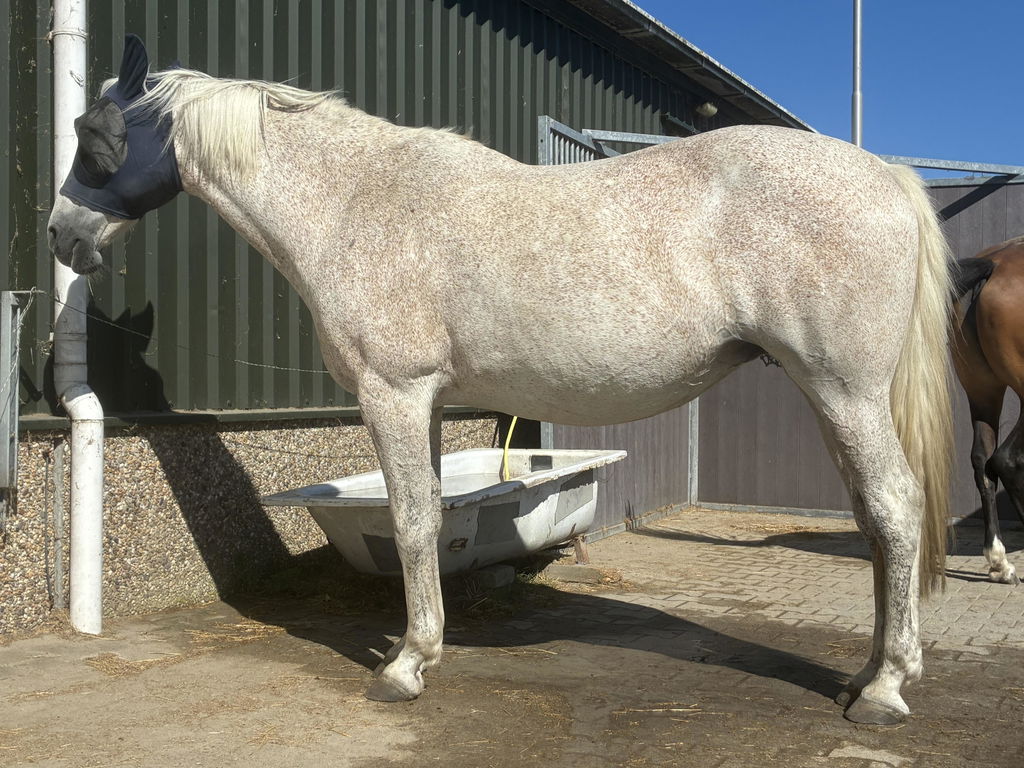

The foal has been weaned, the stable is quieter than usual, and suddenly every bucket feels like a big decision. A useful weanling diet example does not begin with a large concentrate meal. It begins with the forage the young horse can eat calmly throughout the day, then fills the genuine nutritional gaps without pushing growth too fast.
Late autumn often makes this harder to judge. Pasture growth has slowed, turnout may be shorter, and a new batch of hay or haylage may have replaced summer grass. A weanling is growing quickly, but that does not mean he needs an ever-increasing amount of hard feed. The goal is steady skeletal development, a settled digestive system, and enough nutrients for the growth that is actually happening.
Why forage comes first for a weanling
A young horse is built to eat fiber regularly. Chewing forage supports saliva production and gives the hindgut a steady supply of fermentable fiber. This matters just as much after weaning as it does for an adult horse, particularly when the change from mare's milk and pasture has already been substantial.
Forage also provides energy. Good-quality grass hay, haylage, or a suitable combination can cover a significant part of a weanling's daily needs. The question is not whether forage is enough on its own for every youngster. It often is not. The question is what it supplies and what it lacks.
That is why I encourage owners to have forage analyzed where possible. The results tell you more than appearance alone can: dry matter, energy, protein, sugar, and key minerals all affect how the rest of the ration should look. A soft, green haylage may appear ideal but can be quite different nutritionally from a mature, stemmy hay.
In my practice I often see well-meaning owners add several feeds at once after weaning: a conditioning mix, a stud feed, a mineral supplement, and perhaps a handful of treats. The youngster may gain weight, but the ration can also become unnecessarily high in starch, calories, or overlapping vitamins and minerals. More ingredients do not automatically make a better ration.
A practical weanling diet example
Consider a healthy 400 kg weanling with limited late-autumn pasture access. This is an illustration, not a universal recipe. Breed, mature size, growth rate, forage quality, management, and health history all matter.
Start with free or near-continuous access to hygienic, suitable forage. Many young horses will eat roughly 2 to 3 percent of body weight in total dry matter each day, depending on their condition and environment. For a 400 kg youngster, a forage target of about 7 to 8 kg of dry matter per day may be a reasonable starting point. If the hay is around 85 percent dry matter, this is roughly 8 to 9.5 kg of hay as fed. Haylage must be calculated differently because it contains more water.
Then assess the forage analysis and the youngster itself. If the hay provides adequate energy and the weanling is maintaining a moderate body condition, the next priority is usually a properly formulated youngstock balancer rather than a large cereal-based meal. A balancer can provide concentrated vitamins, trace minerals, and quality protein in a small daily amount.
For growth, protein quality matters more than simply choosing the highest crude protein percentage. Essential amino acids, including lysine, are building blocks for tissue development. Copper, zinc, calcium, phosphorus, and vitamin D also need to be present in suitable amounts and proportions. A ration that is energy-rich but poorly balanced in these nutrients is not a good growth ration.
A simple daily structure might look like this:
- Suitable forage offered across the day and night, based on dry matter and the youngster's appetite and condition.
- A youngstock balancer fed at its recommended rate to complement the tested forage.
- Clean water and plain salt available at all times.
- Pasture access when conditions allow, counted as part of the forage intake rather than added on top without thought.
Growth should be steady, not dramatic
A weanling can look awkward from one week to the next. Hindquarters may grow first, the neck may seem too long, and the topline may take time to catch up. That is normal. What is less desirable is rapid weight gain, a persistent fat covering, or pronounced changes in condition after a feed adjustment.
Use a weight tape every two weeks, take photographs from the side and behind, and note changes in body condition. For many young horses, a moderate condition is preferable to a round appearance. You should be able to feel the ribs with light pressure, without seeing them sharply from a distance.
A mare I advised had a weanling who looked ribby shortly after moving to a group with older youngsters. The owner assumed he needed a richer feed. In reality, he was spending too little time at the forage feeder. Once the group management changed and he had reliable access to hay, his condition improved without making the bucket ration much larger. Feeding management is part of the ration.
Check the mineral balance before adding extras
Young horses are especially vulnerable to confusion around minerals because many feeds already contain added vitamins and trace elements. A fortified stud feed plus a balancer plus a general mineral powder can lead to unnecessary duplication.
Calcium and phosphorus deserve particular attention because they work together in bone development. The ratio matters, but so does the total amount supplied by forage and feed. Trace minerals are similarly not a case of more being better. Copper and zinc are needed for normal growth, yet high-dose additions without a reason can unbalance the wider ration.
This is one reason a forage-first plan is easier to manage. Once you know the foundation, you can select one complementary product and feed it consistently rather than building a ration from several overlapping tubs. The principles are explained in my book, The New Feeding Concept: assess the roughage first, then make targeted corrections instead of feeding by habit.
When a weanling needs a different approach
Not every youngster can follow the same example. A native breed that gains weight easily on good hay may need careful control of energy while still receiving a complete vitamin and mineral supply. A larger warmblood youngster in a cold, exposed environment may need more calories to maintain condition. A horse with a history that suggests insulin dysregulation, or a youngster from a mare with metabolic concerns, needs an especially measured approach to sugar, starch, and body condition with veterinary guidance.
Persistent loose droppings, poor appetite, pain, fever, colic signs, lameness, or a sudden change in behavior are not problems to solve by changing supplements alone. Contact your veterinarian for assessment. Nutrition can support normal digestion and development, but it does not replace diagnosis.
Make only one meaningful feed change at a time, and allow enough time to observe the result. A calm feeder, dependable forage access, and a measured ration are often more valuable than a complicated feeding program.
If you would like your youngster's forage, growth pattern, and current feeds assessed together, the clearest next step is to request personal nutritional advice.